
McNairy Release Dates Explained
“Projected release date” is a useful search phrase, but Tennessee does not use it as one all-purpose public field. TDOC FOIL displays Release Eligibility Date and Sentence End Date. Eligibility is the point at which a statutory release process or parole consideration may become available. It is not approval, a gate appointment, or proof of actual release. The sentence end is the calculated endpoint of the term. A TDOC release authorization records an actual Date of Release when release is processed.
A pretrial detainee at McNairy County Jail ordinarily has no sentence-based release date. Bond may permit release once conditions are met, a judge may alter custody, a case may end, or another hold may keep the person confined. Even after a court order, the jail must process it and check other legal restraints. For a sentenced person, the effective sentence date, jail credit, concurrent or consecutive terms, offender range, offense date, credits, and detainers all matter.
“Actual release” also needs context. A person may leave McNairy County Jail through community release, transfer to TDOC, movement to another county, or another custodian. A transfer ends one facility’s custody but does not mean the person is free. The release record should state the type, authority, time, and destination if maintained.
Find McNairy Projected Release Dates
Start with the last known custodian. McNairy County Jail records control a local booking and county release event. Circuit or General Sessions court records supply the judgment, bond order, jail credit, probation terms, or other authority. TDOC FOIL is the public route for a person currently or formerly in state felony custody or supervision. BOP records apply to a federal sentence, not a Tennessee or county term.
- Confirm whether the person is pretrial, serving a local sentence, in TDOC custody, or held through a different sovereign.
- For a state felony record, open TDOC FOIL and search by TDOC/TOMIS number, SID, or name with available filters.
- Match birth date, ID, physical details, offense, and county context before relying on any date.
- Read every active sentence row and record the exact Release Eligibility Date and Sentence End Date labels.
- For a county term, obtain the judgment and jail-credit computation from the clerk and Sheriff’s Office.
- Ask the maintaining agency to confirm the current calculation, active holds, and whether a displayed date changed.
The main McNairy County release-record search explains how to reconcile jail, court, FOIL, VINE, and federal sources. Do not count days forward from an arrest date. Pretrial credit, effective dates, sentence structure, and later orders make that shortcut unreliable.
The official FOIL search screen shows the public starting fields used for Tennessee state offender lookup.
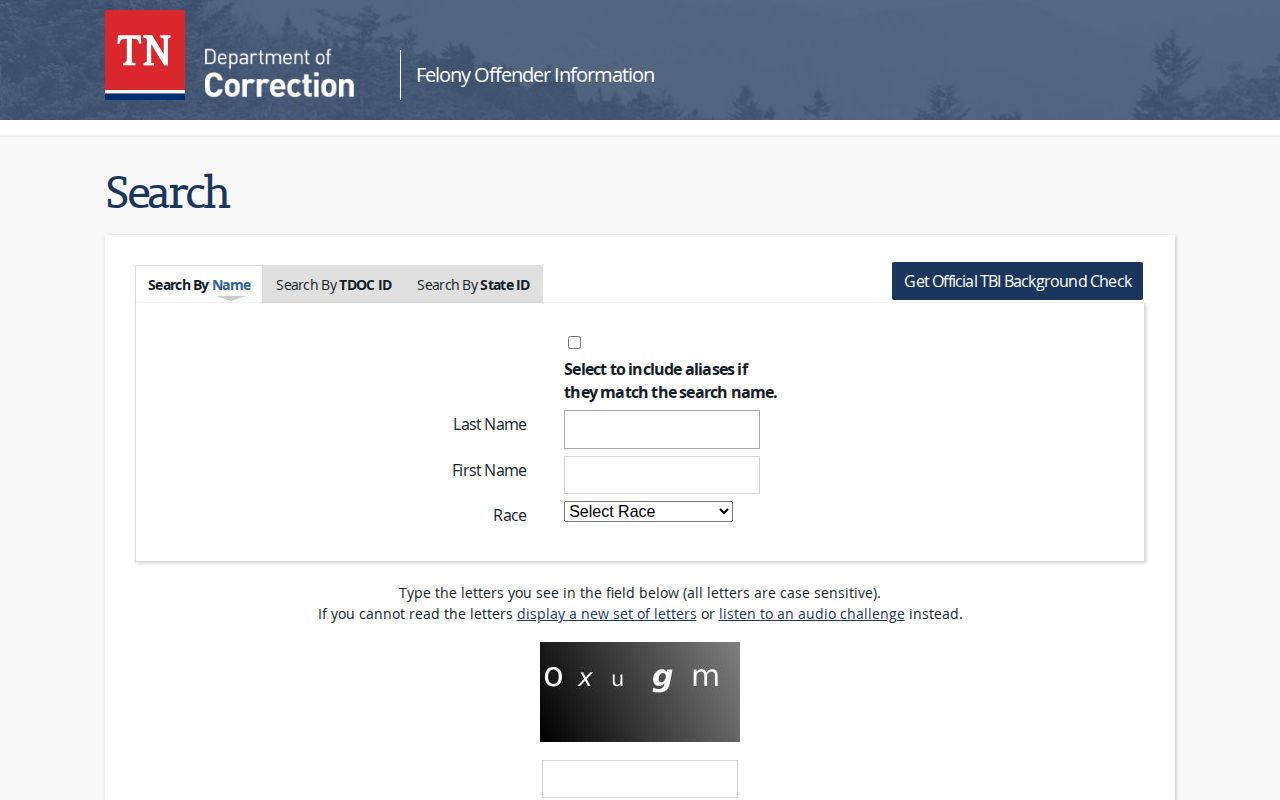
The screen offers name and identifier routes, but the detail record and sentence rows are where the two exact Tennessee release-date fields appear.
Tennessee Credits and McNairy Release
T.C.A. §40-35-501 controls release eligibility across many Tennessee sentences. General ranges can use different service percentages, including 20 or 30 percent for an especially mitigated judgment, 30 percent for Range I, 35 percent for Range II, 45 percent for Range III, and 60 percent for a career offender. Those are eligibility rules, not promised release dates. Specific offenses, the offense date, and the judgment can override the general range structure.
The claim that every Tennessee inmate serves 85 percent is wrong. The statute has defined 85 percent categories and separate 100 percent categories. Some provisions allow limited credit effects, while others restrict them. For covered offenses after July 1, 2024, credits can affect the percentage served before parole eligibility without changing sentence expiration. That distinction is precisely why FOIL’s Release Eligibility Date must not be relabeled as Sentence End Date.
T.C.A. §41-21-236 supplies Tennessee’s sentence-reduction credit framework. Credits may be earned, withheld, or forfeited. They do not create an automatic right to walk out. The controlling offense statute may affect eligibility, expiration, or the practical value of a credit. TDOC sentence staff must apply the judgment, offense date, statutory rules, and verified jail credit.
Note: A McNairy County sentence estimate needs the judgment and official credit calculation, not a simple count from the arrest date.
Why McNairy Release Dates Move
FOIL warns that dates may change as more court documents arrive. A new judgment, corrected jail credit, or recalculation can affect the public display. Multiple sentences must be read together. Consecutive terms add their ineligibility periods under the statute, while concurrent terms run together to the extent ordered. One favorable row cannot safely be isolated from the rest of the record.
| Factor | Possible effect on the release date |
|---|---|
| Verified jail credit | A corrected award can move an eligibility or end calculation when the judgment and law permit. |
| Sentence credits | Earned, withheld, or forfeited credits may affect the calculation within statutory limits. |
| Disciplinary action | Loss or forfeiture of qualifying credits can move a date later. |
| Amended court order | A trial or appellate order can change sentence terms, credit, or effective dates. |
| Consecutive sentence | Added ineligibility periods can extend the point at which release may occur. |
| Parole decision | Eligibility or a hearing does not compel a grant; denial can leave the person confined. |
| Detainer or new case | Another legal hold may prevent community release even when one sentence permits exit. |
A detainer is a request or legal basis for another agency to assume or preserve custody. It can turn an expected community release into a transfer. Revocation after parole or probation can also create a new custody episode, making an older date a poor account of present status.
McNairy FOIL Date Labels
FOIL is built for people currently or formerly in TDOC custody or supervision. Its status field can read incarcerated, probation, parole, or inactive. Probation and parole normally mean the person is outside prison but still under active community supervision. Inactive, when consistent with ended sentence rows, is stronger proof that active TDOC custody or supervision has ended. None of those labels proves what happened in a local misdemeanor case that never entered the state felony system.
- Release Eligibility Date
- The calculated point when release consideration or a statutory mechanism may become available. It is not a promise.
- Sentence End Date
- The calculated endpoint of the sentence, subject to legal and sentence events.
- Parole Hearing Date
- A scheduled proceeding date. It does not show that parole was granted.
- Parole Hearing Result
- The public person-level result field found in FOIL, which must be read with later events and status.
- Supervision Status
- The current state custody or community-supervision category reported in the record.
FOIL may show several active Tennessee sentence rows. Compare them all. A release eligibility date attached to one count cannot override a later date or hold tied to another count. When the display is incomplete, use a narrow TDOC public-record request for the sentence computation or release authorization.
Note: Technical FOIL support can help with the application, but the originating agency must authenticate a person’s release calculation.
McNairy Parole Dates and Release
The Tennessee Board of Parole makes parole decisions. TDOC calculates sentences and supervises people released to parole. A hearing officer’s recommendation is not the Board’s final action, and a scheduled hearing is not release approval. Even a grant can require a suitable release plan, final date calculation, and detainer clearance before the person leaves physical custody.
The Board’s hearing page links prospective schedules that are normally updated weekly. Use a state-prison schedule for a person at a TDOC institution and the county-jail schedule for an eligible state prisoner held locally. A custodial hearing can parole one sentence to another, so it may cause a custody change without return to the community.
For a McNairy person, match FOIL first. Record the TDOC ID, assigned location, Release Eligibility Date, and hearing information. Check the schedule and then the later FOIL or Board outcome. If the status becomes parole, District 60’s Jackson office is the serving-office route, but public staff should not be asked for private case-plan details.
Confirm McNairy Projected Release
For a county jail sentence, request the judgment and jail-credit computation from the McNairy Circuit or General Sessions clerk and the Sheriff’s Office. Ask the jail to distinguish a planned community release from a planned transfer. Administrative office hours do not establish when lawful releases occur, and no official McNairy source publishes a standard release hour or weekend rule.
For a state prisoner, verify FOIL’s current date labels with TDOC when timing matters. A formal release record is stronger than a screenshot because it can identify the releasing authority, actual release date, person or agency released to, identity checks, detainers, and final sentence verification. TDOC Policy 511.03 shows those controls, but it is a state procedure and must not be attributed to McNairy County Jail.
Register through the McNairy County VINELink inmate search for a custody-event alert. VINE can provide timely notice, though agency data may lag. Once an alert arrives, confirm it with the reporting custodian. Ask whether the event was community release, parole, probation, transfer, or discharge. Discharge means the controlling term or supervision has ended, while parole or probation means supervision continues.
Keep five stages distinct: eligible, scheduled for hearing, approved, physically released, and sentence ended. Tennessee records use each stage for a different legal fact. That distinction gives a sound answer to a McNairy County projected release date without turning a tentative calculation into a promise.
If dates conflict, preserve the labels and ask the source agency to reconcile them. A jail exit date, TDOC admission date, parole date, and sentence end date can all be correct because each marks a different event. The key question is not which date looks earliest. It is which date answers the specific custody question and which agency had authority at that stage.