
McNairy Parole and Probation Compared
Parole and probation both allow a person to live in the community under rules, but the authority behind each status differs. Parole follows a prison sentence and a Tennessee Board of Parole decision or another statutory release route. Probation is imposed by a court, sometimes instead of incarceration and sometimes after a split term that begins in custody. TDOC Community Supervision manages field supervision for both. The Board makes parole decisions; it does not serve as the day-to-day field office.
This distinction matters when reading a released-person record. A FOIL status of “parole” supports that the person has left incarceration while the prison sentence continues under supervision. “Probation” shows court-ordered community supervision, but it does not by itself establish where a prior county-jail booking ended. The McNairy County Sheriff’s release entry and the court judgment remain the better records for that local event.
| Record point | Parole | Probation |
|---|---|---|
| Usual starting point | Release from a prison term | Court sentence in the community, sometimes after split confinement |
| Decision maker | Tennessee Board of Parole or a statutory mechanism | Sentencing court |
| Field supervision | TDOC Community Supervision | TDOC Community Supervision |
| Best public lookup | FOIL status, location, sentence, and hearing fields | FOIL status plus the court judgment |
| End point | Formal discharge, sentence end, or another legal order | Completion or discharge under the court and TDOC record |
McNairy Release Terms in FOIL
The words used in Tennessee records carry precise meanings. Reading them together prevents a community-supervision status from being mistaken for complete discharge. It also prevents a scheduled hearing from being reported as a granted release.
- Parole
- Conditional release from incarceration while a sentence and supervision remain active.
- Probation
- Court-ordered supervision in the community, either instead of prison or after a custodial part of a sentence.
- Determinate release
- A statutory route for certain shorter felony sentences that can place a qualifying person on probation after the required service point and notice process.
- Community Corrections
- A court-ordered community alternative. It is not necessarily a release from prison.
- Discharge
- The formal end of custody or supervision reflected by the responsible agency record.
- Absconder
- A person officially alleged to have stopped reporting or otherwise avoided supervision. The label should come from an authorized record.
Check McNairy Post-Release Supervision
The official person-level starting point is the TDOC Felony Offender Information Lookup, commonly called FOIL. It covers people currently or formerly in TDOC custody or supervision. Search results must be matched by more than a name. Compare the TDOC identification number, birth date, photo or physical details when present, offense, sentence rows, and county context. A common name or alias can otherwise lead to the wrong record.
- Open FOIL and search by first and last name, or use a TDOC/TOMIS number or Tennessee SID when one is known.
- Open the matching record and read Supervision Status, Assigned Location, Sentence End Date, Release Eligibility Date, and active sentence rows together.
- If the status says parole or probation, use the official field-office directory to confirm that McNairy County is still assigned to District 60.
- Call the listed district office for public routing help. Ask whether the directory and public record identify the correct serving office, not for confidential case-plan details.
- Check the McNairy court judgment when the question concerns a probation order, split confinement, revocation, or discharge entered by the court.
FOIL uses “incarcerated,” “probation,” “parole,” and “inactive” as distinct status signals. Inactive, paired with completed sentence rows and an ended Sentence End Date, is stronger evidence that active TDOC custody or supervision ended. It still does not replace the Sheriff’s Office record for a short McNairy County jail booking that never entered the state felony system.
McNairy Supervision Uses District 60
McNairy County has no state-listed supervision office inside the county. The TDOC field-office directory assigns McNairy to District 60, whose Jackson office also serves Chester, Fayette, Hardeman, Haywood, Madison, and Tipton counties. The directory lists other offices in the district, but proximity is not the rule. In particular, the Wildersville office is listed for Decatur, Hardin, and Henderson, so it should not be used for a McNairy inquiry merely because it looks convenient on a map.
TDOC District 60, Jackson1661 Hollywood Drive
Jackson, TN 38343
Phone: 731-984-9802
Fax: 731-984-7495 or 731-984-7496
The official directory is the best source if an office assignment changes. Staff can explain how a supervised person should reach the assigned officer and can clarify public routing details. They should not be expected to reveal private treatment plans, protected contact information, victim information, or internal case strategy.
The District 60 directory page shows the regional structure used for McNairy County release supervision.
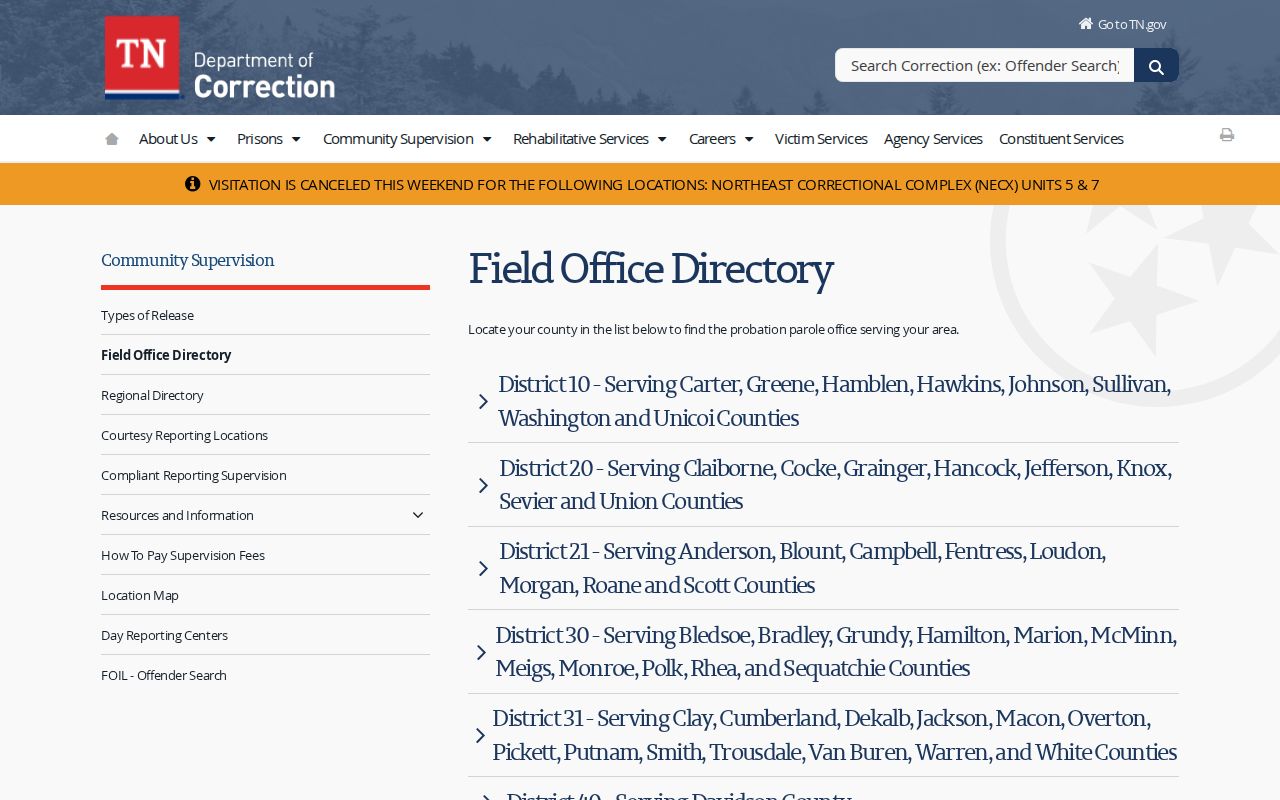
The image helps distinguish the assigned Jackson office from offices serving other counties, but the live directory remains controlling.
McNairy Parole Hearings and Decisions
The Tennessee Board of Parole hearing system is separate from the field office. Hearing officers conduct proceedings and submit recommendations; Board members make the decision required by law and Board rules. Published state-prison and county-jail schedules are prospective. The Board says schedules are normally refreshed weekly, usually on Monday or Tuesday after a Monday holiday, and they can change.
A calendar entry proves only that a hearing was set. It does not show that parole was granted or that a person walked out of custody. A grant may still require an approved release plan, final date calculation, identity review, and clearance of detainers. FOIL’s Parole Hearing Result is the main person-level public result field found in the research. When a formal decision is needed and no public result appears, use the Board’s records procedure.
| Board item | What it establishes | What it does not establish |
|---|---|---|
| Hearing schedule | A prospective hearing date and setting | A grant or physical release |
| Grant decision | Board approval under its process | Immediate gate release before all checks |
| Custodial hearing | Possible parole from one sentence to another | Return to the community |
| Revocation hearing | Review of an alleged supervision violation | An automatic return to custody before decision |
McNairy Supervision Violations and Warrants
Supervision conditions can include reporting, lawful conduct, approved residence or travel, payment terms set by lawful authority, treatment, testing, or special limits tied to the judgment and release plan. The precise conditions belong to the person’s order and supervision record. Public summaries should not guess at them. A violation allegation can lead to investigation, a warrant, a preliminary hearing, or a revocation process, but an allegation is not the same as a final finding.
No official McNairy County absconder list was found. Treat an absconder claim as unverified unless it comes from TDOC, an official warrant source, or the court record. VINE can send notice of certain custody events, but it is not a supervision-condition database. The McNairy Sheriff, court clerk, FOIL, and District 60 each answer different parts of the question.
For a parole matter, Board records may show a revocation event or hearing result. For probation, the McNairy Circuit or General Sessions file can contain violation allegations, revocation orders, reinstatement, or modified terms. A person may remain in the community while a matter is pending, or may be held on a violation warrant. Only the current official record can resolve that status.
Note: A VINE notice is a prompt to verify custody, while a court or TDOC record establishes the legal supervision event.
McNairy State Release Processing
TDOC Policy 511.03 shows how much occurs between eligibility and a state release. Its release authorization records identity checks, detainers and pending charges, release destination, property, clothing and money, state identification or driver-license work, GPS equipment when required, the person or agency receiving the individual, signatures, and gate escort. These are Tennessee state-prison procedures. No official source documents an equivalent McNairy County Jail process, so they must not be treated as local jail promises.
The policy also helps interpret supervision. “Released by,” “date of release,” and “released to” answer different questions. A person released to a supervising agency has left physical confinement but has not necessarily completed the sentence. A detainer can send that person to another custodian instead of the community. The formal release record is more reliable than a name disappearing from a search result.
State reentry help is regionally available through TDOC’s Day Reporting and Community Resource Center program. The Jackson center can connect eligible supervised people and some people released after sentence expiration with resources. Its presence in Jackson does not prove that each McNairy release is assigned there.
Confirm McNairy Supervision Discharge
Supervision ends through a formal legal event, not merely because reporting seems to stop. FOIL may change to inactive and show an ended sentence, a court may enter a discharge order, or TDOC and the Board may maintain the controlling completion record. Read all sentence rows because consecutive terms, a new judgment, revocation, or a detainer can keep another obligation active after one term ends.
For proof, save the public FOIL result and request the relevant official record. TDOC accepts public-record requests for identified documents, while the Board has a separate public-records request process for its decisions. A probation discharge entered by the sentencing court should be obtained from the McNairy clerk. The full county-release and records-request path is available on the McNairy County released inmates search.
Tennessee’s public-record rules permit lawful redaction of medical, victim, security, personal, sealed, juvenile, and expunged material. Ask for the narrow record that answers the status question. That approach is faster to review and less likely to sweep in protected data.